Airfarewatchdog
Welcome!
  • Real deals from your departure city
  • Verified by our Dealhounds

Airlines make billions in fees, yet still lose billions. Some thoughts

rss link Airfarewatchblog


Airlines make billions in fees, yet still lose billions. Some thoughts

By George Hobica

Airfarewatchdog.com

By now, you've seen the headlines: Airlines generate $5.7 billion in checked bag and reservation change fees last year.

And that doesn't even include all the other fees: meals, in flight entertainment, priority seating, priority boarding, and so on.

 And yet: Despite the added fees (not to mention higher fares) the five “legacy” carriers (American, Delta, United, Continental, US Airways) lost billions in the first quarter of 2011. And that was with fuel prices lower than their peak of a couple of years ago.

Some thoughts. And feel free to disagree, it's a free country:

Without the added fees and charges, the airlines would have lost even more, and it's likely that we would have either seen more consolidation and mergers, more capacity cuts, and at least one carrier go belly up or file for bankruptcy protection—which definitely would have led to even higher fares and fees.

It's not for lack of trying

Bottom line: the airlines have cut costs dramatically, reduced capacity, merged, added fees, raised fares, and still they are delivering their product for less that it costs them to do so.

Part of this is the airlines' own fault, perhaps. They have taught consumers to wait for sales. Most travel is discretionary. When airlines raise fares too high, consumers drive, stay home, or wait for a sale. Airlines used to print fares on their schedules if you can believe that...and fares seldom changed.  Only "expectant grandmothers" and mission-critical business travelers will fly at the drop of a hat for any fare they can get.

The only time in airline industry history that the airlines were consistently profitable was when they were regulated by the government, which told them where to fly and how much to charge. Deregulation was in part to blame for scores of airline Chapter 9 and Chapter 11 filings. Remember TWA, Pan Am, Eastern, PeoplExpress, SkyBus, Independence Air, National, Aloha, Midway, ATA, and the rest?

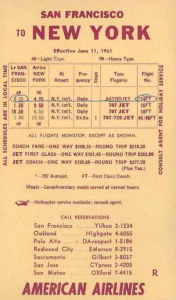
Airline tickets cost way less than they used to. As the American Airlines schedule shown above shows, in 1961 AA charged $218 round-trip to fly between New York and San Francisco, about what it costs today when there's a sale. And that included a steak dinner and pilots wings for the kiddies. But that was in 1961, when you could buy a new car for under $1000.

There is still overcapacity in the worldwide airline industry. Airlines will not be profitable until there are fewer seats, and until most of those seats are chasing the "must-fly" passenger (for example, someone relocating overseas—you cannot drive from New York to Paris).

Some industry observers believe that the only solution is world-wide consolidation. You know those airline alliances—OneWorld, SkyTeam, and Star Alliance? Imagine if they were airlines—the only three airlines. Then you'd see the airlines get pricing power. And perhaps we'd see better service.   

What about Southwest?

Good question. Southwest doesn't charge for the first or second checked bag, within weight limits; and doesn't charge a ticket change fee. And yet it's consistently profitable. But there's a downside. Southwest doesn't play by the same rules. It doesn't allow its fares to be compared side by side on online travel agency sites; it doesn't "interline" with other airlines; it doesn't fly internationally; doesn't assign seats; hasn't joined an airline alliance (e.g., OneWorld); and has a limited route network. Should other airlines follow Southwest's business model?

A downward spiral

And speaking of service, unfortunately, a lot of consumers hate flying at any price. The airlines are reviled for uncomfortable seats, poor service, grumpy staff, delays, unfair business practices and more. An industry that is losing money cannot afford to deliver a quality product.

The economy has also made it difficult for the airlines to raise fares to a profitable level. When consumers are spending $80 to fill their tanks each week, that’s money they can't spend on airline tickets. But it looks like the economy won't spring back to life anytime soon.

Some people argue that the problem is with airline management. They're a bunch of overpaid incompetents. But airlines have cut costs everywhere they can—distribution (selling tickets on their own websites), more efficient planes, mergers, bankruptcy filings to eliminate expensive contracts and pensions, you name it. But nothing has worked, so far.

New U.S. D.O.T. regulations, while for the most part welcome and necessary, are adding to airlines' costs.

So what’s the solution? Is there a solution?

The airlines could cut costs even further but that would impact service further, and more people would find another way to spend their travel dollars resulting in a vicous circle. As I see it, the only way for the airline industry to regain its health is either to re-regulate, which will probably never happen, or a combination of massive capacity cuts and global mega-mergers. Airlines should rethink their tendency to have panic sales when traffic slows down, and retrain consumers to pay what it actually costs to fly, plus a small profit margin. Otherwise, the global airline industry will continue to be a race to the bottom.

So perhaps we should learn to live with fees--paying for what we use when we fly—or suffer the consequences of ending up with a handful of world-wide airlines. Yes, fees should be spelled out more clearly at the time of ticket purchase if not before. The cruise lines industry thrives on a la carte pricing; so do restaurants, hotels, and rental car companies. 

If you have a better solution to an airline industry in crisis, I'd love to hear your thoughts.

The opinions expressed above are the author’s own and do not reflect the opinions of any other entity. 


Post a Comment


(Please do not use your real name - this screen name will be your public identity on Airfarewatchdog.com)
(Your email address will not display in post)


Still, the fees for movies and wi-fi are a rip off! One flight costs as much as one month of hulu.
by littlecmad on Thursday, February 16, 2012
First, I'll let you know that I live in a house divided. In the immediate family we have (current or former) legacy airline management, pilot union officers and (major) online agency management. We have some robust discussions to say the least. You are the first I've seen in media to actually get it. Billions in fees and billions in losses shouldn't make the math too difficult. As you point out, even with the added fees the total ticket prices are still below the cost to operate. I would like to add one more step that is not so obvious, yet oh so damaging when it comes to marketing and revenue. A chicken and an egg dilemma. I just looked at your site for fares, as any consumer would, and found that they are listed in price order. Like all travel sites, they are listed by "base fare", not by total price. I'm sure you can check your metrics and see that like all travel sites somewhere between 80 to 90 percent of fares are booked in the top few selected from base fare. On some pairings it nears 100%. If an airline is not in the lowest three, or at least on the first screen of base fare it is left fighting for 1 or 2 out of ten left over passengers. The airline's necessary reaction is to lower the base fare, a needed response to the consumer's shopping paradigm made possible by the Internet. There are few ways to lower the base fare and the easiest is to "unbundle" the items that go into it, ie checked bags, food, courtesy (yes, courtesy and competence have a price too), etc and to then charge them back later. In fact some of the add on fees are lower than their own costs but the advantage of lowering the base fare and moving up the list is worth a loss in order to sell seats and maintain market share. This is why even after the fees are added back in the airlines still loose money. The fix might not be re regulating airlines, but regulating how the tickets are sold. The free market might also gravitate towards a fix on its own. Metacrawler search engines, internet search tools that actually check other websites and report back, can be programmed to search for total price (like Kayak for example). Once the public gets tires of getting what they asked for, there will be a demand for more clarity, a search for total price and the response will be either free market or government (my money is on the market).
by DR on Tuesday, June 21, 2011
This was a good read. All of my unspoken questions were answered. I feel informed now.
by Super Soul Sista! on Thursday, June 16, 2011
@Astrojet, you're right... the Air Traffic Control system is part of the problem. It costs the airlines a lot of money because it's so antiquated.
by Airfarewatchdog on Wednesday, June 15, 2011
It's a complicated product and a complex delivery system, but it is a free market. Fly, drive, train walk you make the decision. Regulated markets are always an option.
by Giacomo on Wednesday, June 15, 2011
Many US based companies have overseas-based shell corporations where profits are shifted by legal exchanges of services and contracts. These shell corporations shelter money overseas so that taxes don't have to be paid on profits. Teams of tax advisers, corporate lawyers and accountants create plans that purposefully generate minor losses in the US based subsidiaries. I think that the airlines are way more sophisticated in their pricing models, sourcing, and cost reduction strategies (externalizing costs onto their employees, travelers, and onto the taxpayer) than most people suspect. Telling anybody to "learn to live with fees" to help the 'poor struggling airlines' is falling right into their trap to stick their greedy fingers ever deeper into our wallets, purses, and pockets.
by Suspicious on Wednesday, June 15, 2011
Living in Tallahassee, Florida, we see airfare "reality" every day. We NEVER have great sales, and we're soaked for every dime every time we want, or need, to fly. Regulation represented fare fairness to markets like Tallahassee, and that's not been the case for a long time. When you think about it, all of the airline-imposed "rules" are things we're used to, but probably not things that work to the airlines' advantage: can't travel at the last minute, can't change flights, can't, can't can't...Maybe airline executives are indeed like the U.S. car company executives (for the most part)--uncreative, stuck in the past, and overpaid to the extent that they're very comfortable, but their passengers are not. What a sad commentary on the business world...
by Tobyjack on Wednesday, June 15, 2011
Notice how the flight times in the schedule in the above schedule is shorter (!) than the flight takes today? Airlines are building in for delays. The real problem with the airline industry is not stated in this article. It's our out-of-date air traffic control system. Our air ticket taxes are supposed to be supporting improving ATC but are they? We need to improve ATC and that will help the airlines have fewer delays/cancelations and improve the bottom line.
by Astrojet on Wednesday, June 15, 2011
Why not eliminate the 14 day discounted tickets and have the same "normal" price all the time, just like airlines in Mexico do ??
by DLH on Tuesday, June 14, 2011
Could it be we are looking at a site that is an industry puppet, and the joke is on us? Sit on a tarmac for hours and then say it is not justified to have consumer rules...
by travelinman4 on Tuesday, June 14, 2011
The site is censoring my critical comments of their opinion.
by travelinman4 on Tuesday, June 14, 2011
A good start would be if the government cut the taxes on airfare. The tax on a $300 ticket today is $61. That's on par with alcohol and tobacco sin taxes meant to discourage use (according to Nicholas Callio of the Wall Street Journal). And they've gone up 38% in the past decade. Fair?
by LittleEarthquake.com on Tuesday, June 14, 2011
As long as unions are allowed to dictate ridicules working condition and pay scales. US airlines will be absorbed by foreign airlines some day in the future. PS don't expect better treatment, there cost (Union driven) will keep that at bay.
by rincant on Tuesday, June 14, 2011
I'm with you with reregulation. I'd rather have higher fares and have airlines compete on quality than the disaster that flying is now. Maybe something an airline should try is having fixed prices (with better quality). You won't get a $200 transcontinental flight, but maybe for $350 you'll be able to get the ticket whenever you want, you won't be charged extra fees and you'll have a nicer flight. I don't know if having such a product in this economy would work out, but it would be interesting to see how such a company would do.
by mxh on Tuesday, June 14, 2011
@Handy--> I've been told that many non-US airlines receive subsidies from their governments. Not bailouts, but support for their normal operational costs even in good times. I don't know if it's true or not. In the opposite diretion are countries such as Canada, where only Candian airlines (Air Canada, WestJet, Porter and some smaller operations) can fly between Canadian cities; with little or no government subsidies; and little or no government subsidization of airports. All of which drives up both base airfare and taxes/fees for travel within Canada. (It can be less expensive, including fuel costs, to fly from a US city to Buffalo, NY, rent a car for a week and drive to Toronto, than to fly from a US city to Toronto directly.)
by Archon on Tuesday, June 14, 2011
Also, most foreign airlines seem to make money--Cathay, Singapore, British, Lufthansa. How come they can provide better service and still make profits?
by Handy on Monday, June 13, 2011
© 1998-2012 Smarter Travel Media LLC. All Rights Reserved Privacy Statement | Terms of Use
Advertisement
http://rd.airfarewatchdog.com/?ad_user_tracking=%5Bsource%3D%2Ctaparam%3D%2Csupmt%3D%5D