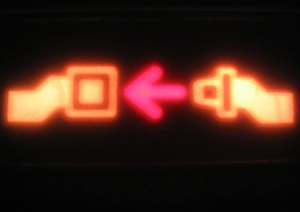
A Texas woman is paralyzed after getting up to use the lavatory, ignoring the fasten seat belt sign, as her Continental Airlines flight approached McAllen Airport in turbulent weather. Naturally, her family is suing Continental. Yes, when you gotta go, you gotta go, but is Continental really to blame? From ABCNews.com. (True, this has nothing to do with airfares, except it does... if people win law suits like this, airfares go up. You and I end up paying. In any case, this woman's family is paying a lot more than the airfare for this flight.)

This isn't about compassion; it's about the law.
As for "fast-moving projectiles," how about a refresher course in physics?
IF she did injure anyone, they would be well within their rights to conduct discovery and ascertain her liability, if any
She also put others at risk by making her body a fast moving projectile.
If you were injured from her falling on you, I'm sure you'd find less compassion.
Why wouldn't you think she would win? McDonald's was warned hundreds of times previously about the coffee temperature, had settled numerous lawsuits brought by people badly burned and disclosed in its own operations and training manuals that their coffee is to be served at over 180 degrees Fahrenheit.
The plaintiff in the case you refer to suffered third degree burns, was hospitalized for over a week, and had to undergo skin grafting procedures.
When you act like a bleeding idiot, refuse to heed reasonable warnings and hurt people badly you get sued ... and if the jury is awake, you lose.
I've also seen people get up from their seat during landings, which makes me very uncomfortable. They are posing a risk to themselves and everyone else on the plane. As for the lawsuit, we are stuck with the system we have and many people/entities refuse to take accountability until forced by a court.
"American Airlines admitted liability, noting that its ground personnel and the flight crew did not take proper steps to detect and possibly avoid the storm, but it claimed the severe turbulence had lasted only 5 to 8 seconds, not nearly 30 seconds, as the plaintiffs claimed. Defense counsel suggested that the passengers were exaggerating their emotional injuries, noting they were able to "continue to live their [lives] and [were] not so incapacitated after what happened on Flight 58.
The plaintiffs told a different story. One testified that the plane bucked and lurched several times and then made a dive, as if it had lost power and was free-falling out of the sky. Another said that passengers and even a flight attendant were in tears. Kreindler told the jury that children who were on board have since become uneasy when cars they are riding in hit bumps and that they are frightened when they see airplanes. He said that although the passengers have gone on with their lives, they are emotionally scarred."
The jury awarded the 13 plaintiffs significant damages.
There's absolutely nothing new in the law of torts in this case; the principles have been around for centuries ... if you don't meet the duty of care owed to another, you may be held to account for it.
Again, I don't think anyone knows at this point whether CO did or not discharge its duty in the case under discussion ... but for those who think they simply get a free pass via a "personal responsibility" defense .... think again.
I've also wondered why more flight attendants don't stop people from moving around when the sign is on...
AND, to the fellow who's asking about when you absolutely "can't hold it in any longer" ... are you 4? (perhaps 104?) c'mon... AND, if you're so frail that you can't control your bladder, you probably shouldn't be walking around on a plane when the seat-belt sign is on, lol.
the fact that so many seat belt signs stay illuminated for the duration of very long flights which encounter NO turbulence tells you why people treat them as advisory
Per your prior post, this is not a criminal trial so the passenger will never be GUILTY of contributory negligence ... if this case is tried -- and tried under Texas law -- the doctrine of comparative negligence applies, which means that if the plaintiff is found to be more than 50% responsible for the injury suffered then s/he will take nothing from the action .... if the plaintiff is less than 51% responsible her damages will be reduced by such percentage ... i.e.: $100,000 damages, P 30% responsible, judgment for $70,000.
These are questions for the trier of fact; I don't know why you assume that plaintiff cannot win when the most salient facts of the case are entirely unknown at this point.
Just to correct the record.....
Like Metri, for instance - you've got some kind of colossal nerve, reserving to yourself the right to decide to get out of your seat when the seat belt sign is on just because you're so 'athletic,' the safety of your fellow passengers be damned. When the plane hits a puff of turbulence and you break my leg because you fell on it because your sorry, selfish butt wasn't in his seat, you can bet you'll be hearing from my lawyers.
How would you feel if you had to relieve yourself and there was absolutely no way to hold it any longer? If you did not go soon then there would be a mess that no one around you would want to see or smell. Would you feel differently then?
Regardless of the court outcome, hope this woman can walk again someday. That is the most important thing.
Even given all of that, I would never think of suing the airline for my very own negligence. But, if they were at fault for leaving the 'fasten seat belt' sign on for most of the flight without cause and that made me have to wait to the point that I could not wait any longer, then I would have a second thought.
As for the unfortunate woman I can not say what is right in here case but I hope the outcome will be a fair one either way it goes.
In short, America needs to get a life and get back to basics. The only person's fault is the one in the mirror. Period.
Suppose you are on a plane and go to the toilet despite the fasten seat belt sign. And suppose further that you are one of the unlucky few who suffers an injury as a result. Would you sue the airline. Perhaps not; after all your health insurance will pay whether it's your fault or not. But if the injury is very expensive, your insurance company may force you to sue. Suppose you have no insurance and the injury was very serious; then would you sue? The answer is more likely to be yes. If we had universal health care, the incentive to sue would be much lower.
If you ran an airline, you would anticipate injuries that were not your fault by setting aside a contingency fund and by hiring lawyers who are smart, smarter certainly than the P.R. people who work for airlines. And if you were a smart lawyer who worked for an airline you might decide that it would be cheaper to settle a lawsuit than to generate bad publicity by going to trial and possibly losing. If you've ever served on a jury you know that cold logic and the doctrine of personal responsibility don't always carry the day.
If the airline wins, what makes us think that it will result in their holding the line on fares? If the airline loses, will they raise fares? Airlines raise fares whenever they can and lower fares whenever they must. They all raised fares because of soaring fuel prices, but they didn't lower them when those prices went back down. They cut employee pay when they went into bankruptcy; will they raise pay when they return to profitability?
As for the paralyzed woman, perhaps it was mostly her fault, but if her injury is real then her suit is not frivilous because that's the way the American legal system works. Personally, I hope that Continental settles out of court. Then we can stop being angry at her and focus on the issues that matter: Why airlines have made the skies such an unfriendly place.
Cheers.
Personal responsibility means when you hurt someone, you pay for it. If the CO flight crew was negligent the company will pay; if they were not, they won't .... LR made that pretty clear and so did I.
If you're really concerned about increasing fares flowing from negligence verdicts I hope you are staying fully up to date on airline safety and only patronizing carriers with outstanding safety records.
Maybe you'd care to share the citations for the "case law on phony lawsuits" you've read. I suspect what you've really been reading is insurance company propaganda about lawsuits. It abounds and it is nearly always misleading or flat wrong.
Instead of blaming higher costs on people maimed and killed by flagrant negligence, why not focus on the companies that refuse to make reasonable efforts to make their products and services safe? If you really have read any negligence case law then you know that it's not really a high standard to meet.
Every single time I fly and see someone get up when the seat belt sign on, it is frustrating to me. They do it because they see others get up. No matter how badly I need to get up, I don't. I set a good example. And it's never been that much of an emergency anyway. I generally use the facilities before the flight or if I know I won't be able to make it the whole flight I use the facilities while the seat belt sign is off. Granted, if she was in there before the sign turned on, that's a different story.
They turn that sign on for a reason. Whether other planes have reported turbulence or they are flying into a storm, they probably know it's coming. In some cases they've probably flown into an unexpected patch and don't know how bad it will get so they turn it on to be safe.
Continental is not responsible.
People, whatever happened to PERSONAL responsibility? Are we not liable for our OWN choices anymore?
There have been several times where I get in the lavatory sign off) and I swear the pilot knows and heads for the turbulence (j/k).
If she blantently ignored the sign and got up anyways, that's her stupid fault and did not listen to the directions of crew members (also part of the contract of carriage). If the plane hit turbulence and the sign was illuminated while she was in there... well that one is hard to argue either way.
This case will NOT turn on the seatbelt sign; it WILL turn primarily on whether the behavior of the crew on the flight deck was reasonable under the circumstances. If the extreme turbulence could not have been anticipated and could not have reasonably been avoided, Continental should prevail. On the other hand, if they knew about it, could reasonably anticipate the dangers, had opportunity to avoid it and decided not to ... say perhaps because they didn't want to waste fuel by altering course ... then I think you have a different outcome.
The short story is that if Continental was negligent, they're going to pay and that's that ... and if they weren't, they won't.
Nobody's ever seen those parking lot signs that say, "Not responsible for lost or stolen articles" ?? It's a nice try on the part of the owners but here too -- as always -- you cannot escape the consequences of negligence merely by posting a sign that you won't be held negligent.
As for your airfares ... airlines anticipate contingent liabilities of this sort and take appropriate risk mitigation steps ... in other words, it's already baked into the fare. Besides, anyone who flies commercially benefits indirectly when airlines have to consider and review their operational procedures.
I hope none of you are ever seriously injured on a flight because you failed to put your seat back or tray table in its full upright position in a fully timely manner ... or ever have to argue over the meaning of what constitutes a "securely fastened" seat belt.
Absolutely this is a tragedy, but people have to take personal responsibility for their own actions. It's not the airline's fault if someone is injured after ignoring a safety notification.
However, if I do choose to ignore the seatbelt sign and get up to go to the lavatory, then I am clearly doing so at my own risk and it's MY fault if I get injured in the process. I will continue to get up and go to the lav when I need to, seatbelt sign or not, but I will not hold and airline responsible for any injuries that I may sustain the process.
If I moved to Germany and didn't speak German, and I boarded a Lufthansa flight from Munich to Stuttgart, or if I moved to Moscow and decided to fly Aeroflot to St. Petersburg, I would not expect any announcements in English. I certainly wouldn't hold the airline responsible for my failure to learn the local languages.
On top of that, the seat belt sign is pretty universal. It's been featured in enough movies and TV commercials that anyone should know what it looks like and what it means. Heck, the "DING" so prominently featured in Southwest's commercials and computer application is probably one of the better-known sound effects, even among people who don't fly often.
Then again, the woman's case could be made harder to prosecute if she's done any significant air travel before.
And I didn't mean to target Archon as strongly as I did--he/she was simply bringing up some points to discuss and didn't appear to actually be advocating any particular side of the issue. Sorry if I came off too strongly! :)
Still, I will be greatly irritated if CO loses the case.