Travel Q&A
You can submit your own question to us at askgeorge@airfarewatchdog.com. We will try to answer as many as possible.
To post a comment to one of our Q&A's please click on "read more" and then "post a comment."
Current posts |
Categories
Entries by Tracy Stewart
Q. How do the airlines set their prices? After seeing airfare for a particular schedule jump 100% from the time I started my search to when I actually tried to book it 3 minutes later, I was given the old "supply and demand...someone somewhere must have booked a seat in that span, and that caused the jump." How is that legal or possible?
A. We've heard this story time and again. Airlines only sell a certain small number of seats at their lowest fares. A flight might have a dozen different economy class fares, with a certain number of seats available at each fare. The price of each fare class can be set throughout the day, plus the airlines employ dozens of airfare analysts who do nothing all day but adjust the number of seats available in each fare class. That's why it's so important to check fares many times throughout the day and over a number of days if you can't find what you believe to be a reasonable fare. A fare might be $300 one minute, and the next it could be $200. Since airlines were deregulated in 1978, they are free to set whatever prices they wish.
Q. My son was recently delayed for three hours on a domestic trip due to a maintenance issue. They sat on the plane for two hours before being moved to another plane and were delayed further. The delay caused him to arrive at 12:18 a.m. and caused significant hassle for our family in trying to retrieve him from the airport over an hour away from our home. (I received 11 email messages from the airline, each extending the delay.) The airline did not provide food or beverages for the passengers. I called and asked the airline to put him up in the hotel across the street from our home airport so that I could get him the next morning since we had logistical issues with driving at that time of the night. They refused. The airline's contract of carriage states that they will provide accommodations if the delay pushes the arrival to the next day (it did). Also, I had selected that flight instead of a cheaper one so that the timing of pick-up would work for my family. Instead, their failure cost me an entire night of sleep, my son an extra three hours on a plane and a major headache due to not eating for eight hours, as well as the extra cost of the more convenient flight I didn't receive benefit for. I have yet to hear from the airline. How can they get away with this?
A. They can get away with this because, despite new and more stringent D.O.T. regulations, the airlines seem to be a protected industry that doesn't play by the same rules that other consumer segments do.
And although I hate to say it, while I sympathize with you, your tale of woe pales in comparison with many of the ones I read on a daily basis. I wholly agree that if you paid for a more expensive flight arriving at a more convenient time, and instead ended up with what amounts to an "inferior product"—especially since this was due to a mechanical problem that was arguably within the airline's control—then you should be compensated. But there are no government regulations dealing with this kind of scenario. I would complain to the U.S. D.O.T. here and harass your airline's customer service department until you at least get a voucher good for a future flight.
Q. I have read your recent posts about shopping through airline websites and registering your credit cards to get bonus frequent flyer miles. That is brilliant! But, here is my question: If you use a credit card that gives you frequent flyer miles, do you get the miles on your credit card, and on the airlines that you choose? And, what if you registered your cards on, say, three different airlines. Would you get frequent flyer miles on your credit card and all three of the airlines simultaneously (assuming they all are participants in that particular store)?
A. The reader is referring to an article I wrote and tweeted about warning people that if they're going to shop online it's foolish not to do so through the airlines' shopping mall sites. For those who missed it, airlines award bonus frequent flyer miles (in addition to any miles awarded by using an airline-affiliated credit card) when you shop at over 300 online merchants. Same prices, same stores, same merchandise—the only difference if that if you buy an Apple iMac, for example, at Apple.com you only get miles from your credit card; but if you buy it on Apple's website by first going through an airline shopping mall, you might get an addition one to four miles per dollar spent. These are the same merchants you already shop at: Macy's, Sears, Target, Wal-Mart, Gap, Barnes and Noble, AT&T Wireless, Netflix, the iTunes Store—the list goes on and on.
Now to the question: yes, you do get the bonus miles in addition to miles earned by using your credit card. But no, you can only get miles on one airline at a time per purchase. Click here to see links to all the airlines' shopping malls.
Q. Would you please give us a breakdown of all the taxes that are added to airline fees? I can't think of any other service/product you can buy for which the taxes can almost double the total price. What's up with that?
A. Well, for starters, there's a federal segment fee for each takeoff. So depending on whether you choose a non-stop or a connecting flight, the fee will change. The number of connections changes this fee as well.
Facility fees charged by the airports. These vary depending on the specific airports that are included in your itinerary. And again, the more connections, the more fees.
The TSA charges a security fee and that varies depending on the airport.
The airline itself can charge fees, including a fuel surcharge. Theoretically, you're supposed to see this in the base price, but anecdotal evidence suggests that this not always the case.
For international travel, there are additional US government taxes, and you can be sure that immigration, customs and the government of your destination country will be sure to take a cut too. This can result in the "sticker shock" of seeing your ticket double in price (sometimes even more!) when all the extras are added up.
Q. Why are the airlines allowed to get away with price gouging during the holidays? Flights that were $300 a month ago are now $800 or more during Thanksgiving week... it's awful. The airlines are capitalizing on people's desire to spend the holidays with their families.
A. Airfares always go up for holiday travel. Peak holiday fares will be at least 10 percent higher this season than last, and will be even more pricey on some routes. It's all due to the airlines having cut tens of thousands of seats for the holiday season and because of airline mergers. Delta no longer competes with Northwest because they're the same airline now. Southwest doesn't compete with ATA and Airtran because it bought them. Continental and United are one, as are Midwest Airlines and Frontier. Despite the higher costs, adjusted for inflation, airfares are lower now than they were 20 or 30 years ago. No wonder the airlines have lost billions over the last decade: they're selling the product for less than it costs them to provide it. And, of course, it's all about supply and demand. With fewer seats, airlines can charge what the market will bear. To save money on Thanksgiving travel, consider taking an early flight on Thanksgiving Day and returning the Saturday after the holiday rather than on Sunday. It's always possible that fares will come down just before the holidays, so be sure to check often and sign up for free emailed airfare alerts.
Q. I haven't traveled in a while and will only be taking carry on luggage with me. Is there a weight and size limit? Also, I noticed that airlines now charge baggage fees. Does American charge a fee?
A. While there is no weight limit on carry on bags, all airlines have a size limit for bags taken into the cabin. In general, you're allowed to carry on one bag measuring no more than 22 inches long by 14 inches wide by 9 inches tall, plus one small "personal item" such as a pocketbook or laptop case. On American, that personal item must not exceed 36 inches in overall dimensions and should fit under the seat in front of you. American charges for checked bags; Southwest lets you check two bags for free as long as they don't weigh over 50 pounds; JetBlue gives you the first checked bag free; and only Spirit also charges for carry on bags unless they're small enough to fit under the seat in front of you.
Q. I am flying United this week and just checked in online. I was forced to buy an "Economy Plus" seat with extra legroom because there were no remaining seats in regular economy. This is the second time this has happened to me with United, but it has never happened with other airlines. I fly nearly every week and I am about to cross United off my list of airlines. Is there any way around this in the future if I have to fly United?
A. This is a growing problem not just with United but also with other airlines, such as US Airways, that sell "premium economy" seats for an extra fee. One method is to not choose a seat assignment when checking in online. You'll probably get the extra legroom seat for free, but you won't be able to choose your exact seat location, meaning that you might end up in a middle seat. But you'll avoid the extra fee.
Q. I just bought a 21x15x8.5 sized carry-on...while most airlines seem to allow a total of 45 inches, I'm reading some airline's carry-on sizers (such as AA) are 22x14x9. Will my extra inch on one side get me in trouble or am I worrying too much?
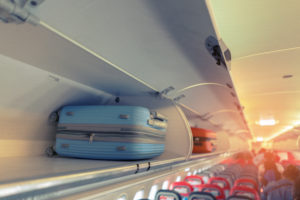
A. Nah, you should be in the clear. Usually, it only matters if your flight is packed to the gills and everyone's bringing carry-ons onboard. We're always amazed at the size of some of the bags people lug aboard the plane. That's when they'll start looking for reasons to gate check you. Of course, even if you're well within their stated size that's still no guarantee that you're baggage will be allowed onboard if there's no room in the overheads. Whenever possible, we try to keep things small enough to fit under the seat in front of us, to avoid overheads entirely.
Q. What are my rights if a piece of checked airline baggage goes missing?
A. It depends on what you mean by missing, and whether the flight is domestic or not. If the bag is lost forever on a domestic U.S. flight, then you can claim up to $3300 in compensation from the airline, but you'll have to produce receipts for the value of the bag and its contents, which is why I advise readers to save every receipt for clothing purchased. Note that "valuables" such as electronics, jewelry, antiques, cash and other similar items will not be covered by the airline (these should always go in your cabin luggage), and the airline will attempt to depreciate the value of your possessions, just as an insurance company would in the event of a loss. The rules are different for checked baggage lost on flights originating or flying to non-U.S. destinations. Many countries and thus airlines follow a set of rules called the Warsaw Convention, which limits liability for loss or damage to luggage at $9.07 per pound ($20.00 per kilo) for checked baggage with a maximum of $640, and $400 per passenger for unchecked baggage, unless a higher value is declared in advance and additional charges are paid. Most travel, however, will be governed by the newer "Montreal Convention," which stipulates higher liability limits for international flights (but it's still less than domestic liability). That’s why it’s so important to buy excess valuation coverage,where available, when checking bags on an international flight. Ask about this coverage when you hand over your luggage at the airport. It's surprisingly inexpensive, ranging from 50 cents to one or two dollars per $100 of coverage. If your bag is merely "delayed" rather than totally lost, however, things get murkier. If you can prove consequential damages, the airline is still liable up to the amount stipulated above, but such damages may be difficult to substantiate. For example, if your business suit was in the delayed luggage and you were scheduled to speak at an important conference the next day but were traveling in your gym clothes, you could justifiably buy a new suit and attempt to charge the airline. However, you wouldn't want to buy a $3000 suit. Reasonable behavior is advised in such circumstances.
Q. I live near Kansas City and my parents live near Tucson. They are both quite elderly and I know that it won't be long until I have to make a fast flight out there. My question is where would I get the best flight deal? I know that airlines do have some sort of bereavement fares, but would I be better going to Priceline or some site like that?
A. Priceline.com’s “name your own price” feature is actually a great source for last minute fares, and in most cases will be less than the airlines’ bereavement fares. The only real downside to using Priceline is that you won’t know exactly what time of day your flight will depart or arrive, or what airline you’ll be on, until you complete your purchase. So it’s not ideal for everyone, but in the scenario of attending a funeral you’d probably want to arrive the day before in any case, since you never know if your flight might be cancelled or delayed and a funeral is something one should arrive on time for.
|
|
- May, 2013 (10)
- April, 2013 (15)
- March, 2013 (6)
- February, 2013 (11)
- January, 2013 (14)
- December, 2012 (6)
- November, 2012 (4)
- October, 2012 (5)
- September, 2012 (10)
- August, 2012 (3)
- July, 2012 (6)
- June, 2012 (7)
- May, 2012 (5)
- April, 2012 (9)
- March, 2012 (7)
- February, 2012 (6)
- January, 2012 (9)
- December, 2011 (9)
- November, 2011 (9)
- October, 2011 (9)
- September, 2011 (7)
- August, 2011 (15)
- July, 2011 (10)
- June, 2011 (8)
- May, 2011 (7)
- April, 2011 (11)
- March, 2011 (11)
- February, 2011 (11)
- January, 2011 (14)
- December, 2010 (8)
- November, 2010 (9)
- October, 2010 (10)
- September, 2010 (8)
- August, 2010 (10)
- July, 2010 (10)
- June, 2010 (8)
- May, 2010 (4)
- April, 2010 (8)
- March, 2010 (2)
- February, 2010 (4)
- January, 2010 (7)
- December, 2009 (8)
- November, 2009 (7)
- October, 2009 (9)
- September, 2009 (12)
- August, 2009 (11)
- July, 2009 (8)
- June, 2009 (5)
- May, 2009 (7)
- April, 2009 (11)
- March, 2009 (13)
- February, 2009 (18)
- January, 2009 (12)
- December, 2008 (11)
- November, 2008 (7)
- October, 2008 (14)
- September, 2008 (12)
- August, 2008 (17)
- July, 2008 (18)
- June, 2008 (10)
- May, 2008 (20)
- April, 2008 (13)
- March, 2008 (11)
- February, 2008 (13)
- January, 2008 (13)
- December, 2007 (9)
- November, 2007 (12)
- October, 2007 (10)
- September, 2007 (11)
- August, 2007 (19)
- July, 2007 (14)
- June, 2007 (16)
- May, 2007 (17)
- April, 2007 (14)
- March, 2007 (7)
- January, 2007 (3)
- October, 2006 (3)
- September, 2006 (3)
- August, 2006 (2)
|